AchiralAchiral

Concepts · Humans and machines

Reviewed2026-07-03

Architecture of a Memory-Native Organization

A four-layer AI memory architecture for organizations where team operations, operational tools, shared memory, and model providers compound into better decisions.

An AI-native team is not a team that uses chatbots. It is a team whose work compounds because the organization can remember what happened, why it happened, who decided it, which exceptions mattered, and which patterns should shape the next decision.

That difference sounds subtle until you operate at speed. A team can add AI to every inbox, document, CRM, ticket queue, and codebase and still remain forgetful. Each assistant may be useful in isolation, but the organization still asks the same questions, rediscovers the same context, repeats the same handoffs, and treats yesterday's work as if it happened in another company.

The strategic unlock is shared operational memory: a living layer that sits between the work of the team and the models serving that team. It is not a larger prompt, a folder of notes, or a vector database with a nice search box. It is infrastructure for continuity.

The four layers of a memory-native organization

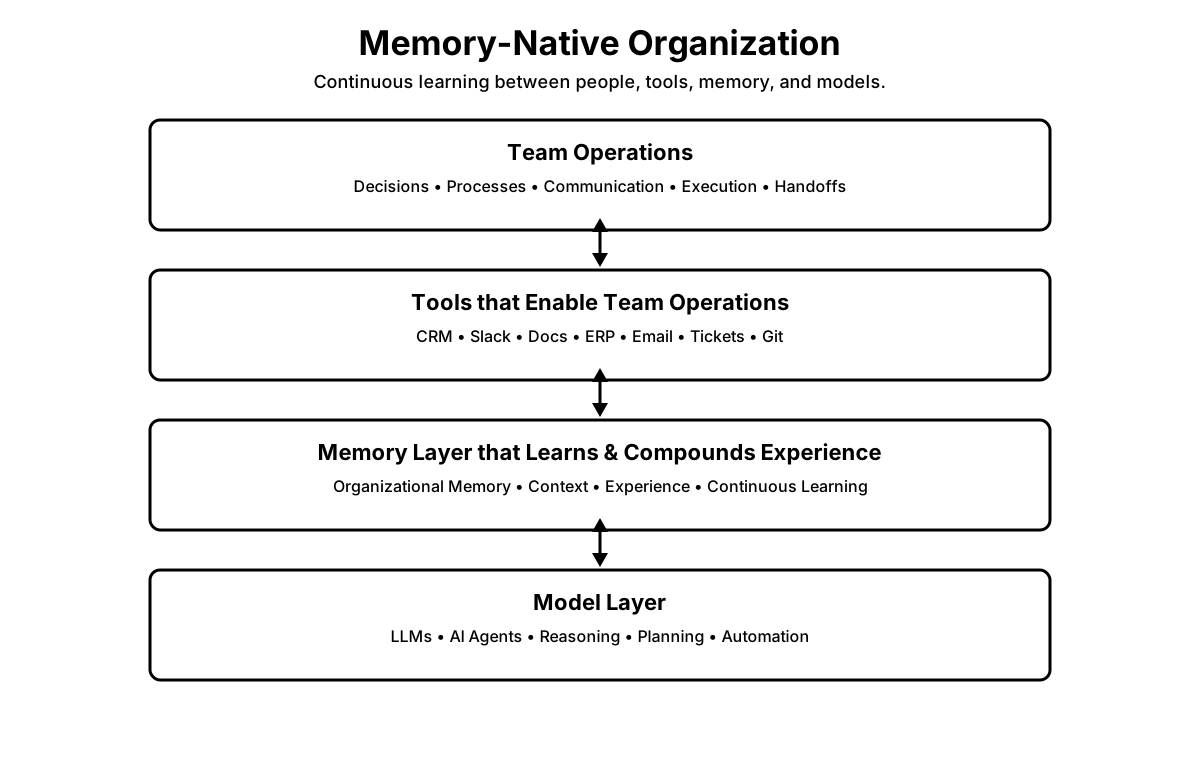
No matter which AI model provider, vendor, or workflow stack a company chooses, the architecture resolves into four layers.

Architecture of a memory-native organization: team operations and operational tools feed shared AI memory that learns and compounds before grounding the model layer.

Four-layer AI memory architecture. Team operations create signals in operational tools. Shared AI memory is the central differentiator: it learns from decisions, reinforces useful context, enriches prompts before they reach the model layer, and absorbs outcomes from responses on the path back.

This is the practical shape of an AI memory-native company. Each layer has a job. Each layer can be improved independently. But the value only compounds when the loop is closed.

Layer 1: Team Operations

The first layer is the work itself. Customers ask for things. Sales teams make promises. Engineers change implementation plans. Operators discover exceptions. Leaders set priorities. Finance constrains spend. Support notices recurring confusion before product does.

This is where company knowledge is born. It is also where most company knowledge is lost.

The mistake is to think of memory as something people write after the work is done. In a real company, the most important context is usually embedded inside motion: the uncomfortable tradeoff in a meeting, the reason a customer was handled differently, the failed experiment that should not be repeated, the quiet approval that unblocked a deal, the edge case that changed the product roadmap.

A memory-native team treats daily operations as the primary source of truth. The goal is not to make humans document everything. The goal is to let the organization notice what matters as work happens.

Layer 2: Workflow tools

The second layer is the tool surface: email, docs, chat, CRM, tickets, code, calendars, support systems, finance tools, project trackers, and custom internal apps.

Most companies already bought the nervous system: email, docs, chat, CRM, tickets, code, calendars, and support tools. The everyday stories live between those systems, split across tabs and threads, then quickly buried by the next urgent thing.

What companies still lack is a learning memory substrate: a layer that consumes signals from tools of record and turns them into actionable context.

Workflow tools are excellent at storing artifacts inside their own boundaries. They can tell you the latest ticket status, calendar invite, pull request, Slack thread, Salesforce note, signed order form, or support transcript. But they rarely understand the operating meaning that crosses those boundaries, or which version of the story is current.

The memory-native posture is different. Tools become signal sources. A chat message is not just a message. It may be a decision, a risk, a repeated customer objection, a policy exception, or evidence that an old memory should decay. A document is not just a document. It may be a source of durable truth, a temporary plan, a draft that should not be promoted, or a stale artifact that should be superseded.

This layer needs connectors, permissions, event capture, and a clean integration model. But the strategic point is simpler: the workflow stack should feed memory without asking the team to become librarians.

Layer 3: Team Memory (or Harness Optimization)

The third layer is the memory system itself. This is the layer that makes the architecture AI-native rather than AI-decorated.

Shared AI memory is responsible for turning raw operational signal into useful future context. It should extract what matters, preserve provenance, respect permissions, rank by usefulness, decay stale context, reinforce what proves valuable, and consolidate repeated patterns into higher-order knowledge.

This is why memory is not the same thing as storage. Storage answers, "Where did we put the thing?" Memory answers, "What should shape the next action?"

For Achiral, this is the role of Chiro: an organization-wide memory layer inspired by cognitive architecture ideas such as activation, retrieval, decay, reinforcement, and goal-sensitive context. The claim is not that software has a human mind. The claim is that teams need a memory architecture that behaves less like a filing cabinet and more like an adaptive operating state.

The governance boundary belongs in this layer, too. Memory without permissions becomes surveillance. Memory without provenance becomes rumor. Memory without decay becomes clutter. Memory without review becomes an untrusted automation system. The memory layer must know who can use what, why a memory exists, how strong it is, and when it should stop influencing the company.

Layer 4: Model Providers

The fourth layer is the model layer: frontier models, private models, local models, specialized models, routing policies, and inference infrastructure.

Models matter enormously. But in a memory-native architecture, models are not the whole product. They are reasoning engines operating over a governed memory state.

That distinction matters because model capability changes quickly. The best model for a legal summary, product triage, sales follow-up, financial analysis, or internal search may change over time. A company should be able to adopt better models without rebuilding its organizational memory every time the frontier moves.

The memory layer stabilizes the company while the model layer improves. It gives each model the context it is allowed to know, the history it should consider, the policies it must respect, and the feedback it needs to learn from outcomes.

The loop is the advantage

The value of these four layers is not in the diagram. The value is in the loop.

  1. Work produces signals.
  2. Tools carry those signals.
  3. Memory turns signals into durable context.
  4. Models use that context to help the team act.
  5. Outcomes feed back into memory.

Simple ACT-R Map

How emergent memory enriches the model loop

Memory is not pasted onto the side of an assistant. It shapes the prompt on the way in, then learns from the response and outcome on the way back.

  1. 1

    Request

    The work asks a question

    Work signal

    A user, workflow, or tool asks for help.

  2. 2

    Emergent memory

    Relevant context activates

    Activated context

    Recent, repeated, approved, and relevant memories rise.

  3. 3

    Enriched prompt

    Context enters the model

    Grounded prompt

    The model receives scoped context, policy, and intent.

  4. 4

    Response

    The model acts

    Useful answer

    The response, action, or recommendation goes back to work.

  5. 5

    Memory update

    Outcome changes future context

    Reinforcement

    Accepted, corrected, or ignored outcomes reshape memory.

Step by step

1. Ask - A task creates a need for context.

That loop is the compounding mechanism. A conventional AI deployment gets a little better when the model gets better. A memory-native team gets better when the model gets better and when the company learns.

This is the same distinction that separates a warehouse from a flywheel. A warehouse accumulates inventory. A flywheel stores momentum.

What leaders should measure

The useful metrics are not only prompt counts, token spend, or how many employees tried a new assistant. Those are adoption signals. They are not proof of operating leverage.

A memory-native team should ask harder questions:

  • How often does the AI retrieve context the user did not know to provide?
  • How often does it prevent repeated work, repeated mistakes, or repeated explanations?
  • How quickly do new team members become useful because memory carries the operating context?
  • How much less time do experts spend answering questions they have answered before?
  • How often do decisions, customer promises, exceptions, and policies remain available after the original thread goes cold?
  • How reliably can the organization explain why a memory influenced an answer or action?

The best systems reduce organizational amnesia. They make the company feel smaller, sharper, and more coherent as it grows.

If you are reading this with a real team in mind, the gentle next step is to give the work a place to remember. You can create a shared AI memory account for your team when it feels useful, then start with one handoff, one workflow, or one customer account where context keeps slipping through the cracks.

Implementation principles

Start with the operating loop, not the model catalog. Pick one workflow where context loss is expensive: customer handoffs, support escalation, sales engineering, executive operations, product triage, compliance review, or onboarding. Wire the relevant tools into a memory layer. Define what should be captured, what should be ignored, what requires review, and who can retrieve it.

Prefer durable primitives over brittle demos. A beautiful assistant that cannot remember across tools is a demo. A plain assistant grounded in trusted memory can become infrastructure.

Treat permissions as physics. The system should not "try" to respect boundaries. Boundaries should constrain retrieval, ranking, summarization, and action by design.

Make memory inspectable. Users should be able to understand the source, confidence, freshness, and scope of important memories. Trust grows when the system can explain itself.

Let stale memory decay. A memory-native organization does not remember everything forever. It remembers what continues to matter.

Close the feedback loop. When an answer is useful, a recommendation is accepted, a customer issue is resolved, or an automation is corrected, the system should learn from that outcome.

The destination

The end state is not an AI sidekick for every employee. That is useful, but it is not enough.

The end state is an organization that can think with continuity. A team where the next person to touch a customer, ticket, feature, deal, or decision inherits the relevant context without digging through ten tools. A company where AI does not merely respond to prompts, but participates in the memory of the business.

That is what makes a team AI memory-native: not more chat, but less forgetting.

Continue with Emergent Memory System, RAG vs AI memory, or ACT-R memory architecture.