
Essays · Founder think
Life, memory, and intelligence as emergent patterns arising from the interactions of simpler things.
Reviewed by Marvin Danig on 2026-10-23. Report issues to editor@achiral.ai.
Emergence Is Being Alive

In my opinion, emergence is what we feel as being alive. Emergence is being alive.
I do not mean that as poetry. Or at least I do not mean it only as poetry.
Emergence is something that appears or occurs out of seemingly nowhere when many small things or events interact with each other in large numbers long enough to become a new thing. It may be life, intelligence, identity, or anything that fascinates our "pattern hungry" brain into the state of awe.
For example, life as we know it emerged on Earth over millions of years. Galaxies with billions of stars spiraling around a black hole emerged over billions of years.
No neuron contains a thought. No single memory contains a self.
And yet here we are.
This is the part of intelligence that still feels underbuilt in AI. We keep trying to give systems more parts: more context, more tools, more files, more retrieval, more tokens. Those things matter. But life does not come from having a large inventory of parts. Life comes from the pattern that forms between them.
That pattern is not decoration. It is the thing.
A body is not alive because it stores atoms. It is alive because those atoms keep producing a self-maintaining process. A mind is not intelligent because it has facts. It is intelligent because experience changes what it notices, remembers, trusts, and does next.
That is why I keep coming back to emergence.
If intelligence is going to become more than a brilliant moment inside a prompt, it needs the same kind of continuity living systems have. It needs memory that forms, decays, repairs itself, and learns from consequence. It needs to become a little different because something happened.
Mathematics of emergence
The useful thing about emergence is that it is not mystical. It can feel mystical because the higher-level pattern is not visible in the lower-level rule. But there is mathematics for this.
There is no single equation for emergence. There are several ways to describe the same basic move:
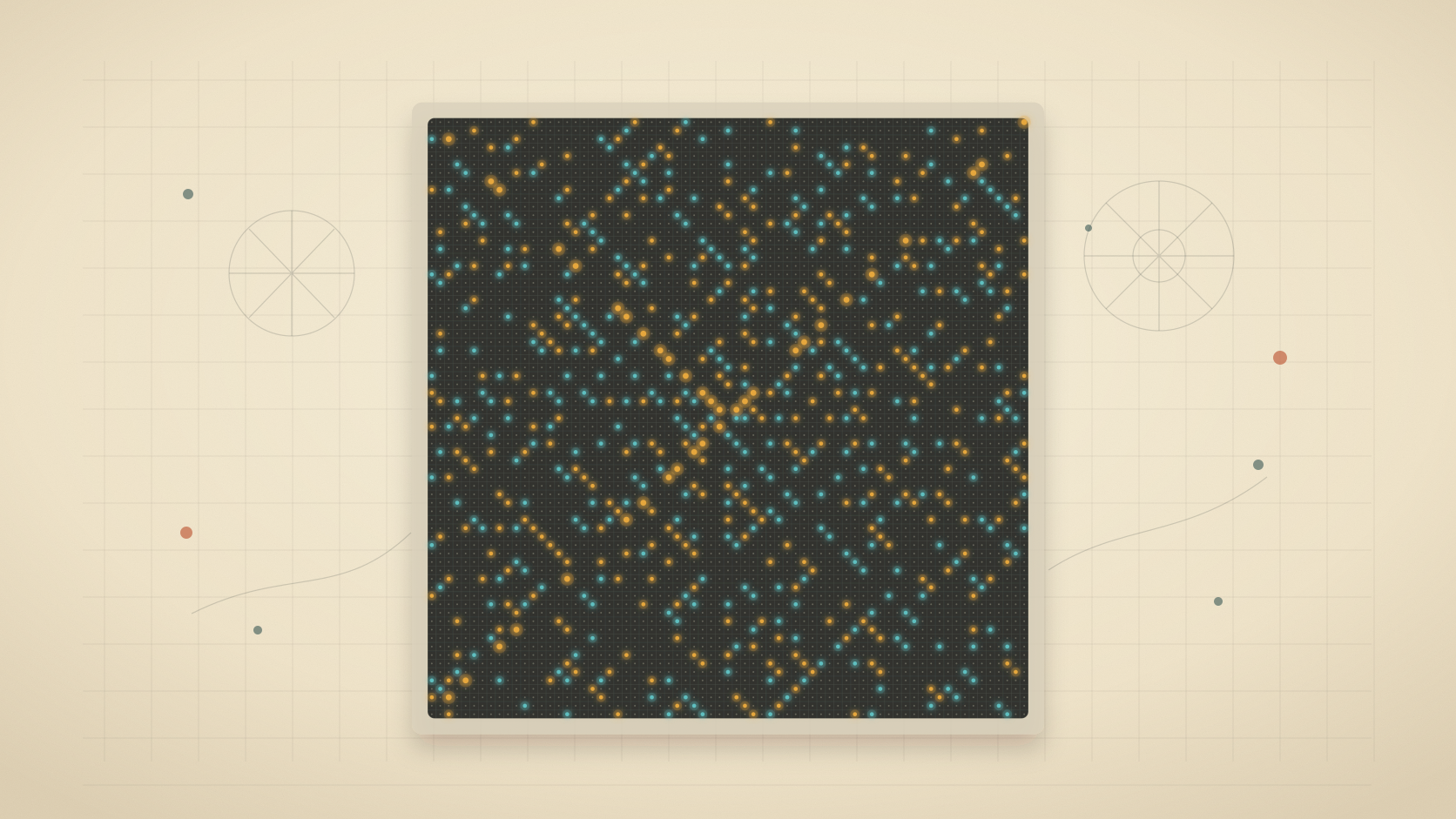
Prime numbers are simple to define one by one, but their positions can still form surprising large-scale structure.
The simplest example is probability.
Flip one coin and the result is uncertain.
Flip the coin many times and something steadier appears.
No single flip knows the final ratio. But over many flips, randomness starts to look like order. Certainty appears at the level of the group.
Statistical mechanics gives a deeper version of the same idea.
An atom does not have temperature. A molecule does not have pressure in the way a gas has pressure. Those properties appear when there are many particles moving together.
Entropy is often written as:
Here, is the number of microscopic states that can produce the same visible state. The large thing we can measure comes from the many small ways the system could be arranged underneath.
This is very close to how I think about memory. One experience is not a self. One note is not a belief. One correction is not wisdom.
But enough experience, compressed and weighted over time, can become a pattern that guides action.
Cellular automata make this even easier to see. In Conway's Game of Life, each cell follows a small local rule.
That is it.
But let the grid run and you get stable structures, loops, moving shapes, and even computation. The interesting thing is not the single cell. The interesting thing is what repeated local updates make possible.
Nonlinear dynamics show why small rules can produce very different worlds. The logistic map is a tiny equation:
For some values of , the system settles. For others, it oscillates. Then it becomes chaotic.
One parameter changes, and the whole system changes phase. That is a useful warning for anyone building memory into AI systems. The behavior of the system is not only in the components. It is in the update rule.
Networks give another view. Take a graph:
The nodes matter, but the edges often matter more. In a random graph, when the chance of connection passes a critical threshold, a giant connected component appears. Before that threshold, you have scattered clusters. After it, you have one large connected structure.
Nothing magical happened to any single node. The relationship pattern changed.
Information theory gives the cleanest language for why this matters. Sometimes a large messy sequence has a small hidden rule. What looked like noise becomes structure once you find the compression.
Kolmogorov complexity writes this as:
That points to one useful definition:
It is not the only definition. But it helps.
A life is not every atom listed in order. A company is not every Slack message. A person is not every memory preserved at full resolution.
The living thing is the compression that still acts.
There is one more idea that matters: some systems are computationally irreducible. Even if the rules are simple, there may be no shortcut to knowing what happens. You have to let the system run.
This is why emergence can be hard to fake. You cannot always summarize your way to it. You cannot always prompt your way to it. Sometimes the pattern only exists after time has passed and the system has changed through experience.
Why this matters for memory
Storage is not emergence.
Storage preserves. Memory changes.
A database can keep a record of what happened. Memory decides whether that record should matter again. It asks a harder question:
What should this experience do to the future?
This is why I do not think the future of AI memory is one giant context window. That is not life. That is a transcript with ambition.
Living memory is smaller and stranger. It forgets most things. It reinforces some things. It links events that did not arrive together. It changes trust after a prediction fails. It notices repetition. It repairs itself when the world changes.
Most of all, it turns the past into a pressure on the next action.
That is the difference between stored information and memory.
Stored information says:
Memory says:
An experience becomes memory. Memory changes belief. Belief changes action.
That chain is where intelligence starts to feel alive.
The shape of a self
The strangest thing about emergence is that it makes identity less solid and more real at the same time.
You are not one thing. You are a pattern that has held long enough to answer to a name.
That does not make the self fake. It makes the self alive.
A person is not a fixed record. A person is a continuously updated process. Some experiences barely move the system. Some experiences change the weight of everything after them. Some become part of the story. Some become reflex. Some disappear, but leave a shape behind.
This is also true of teams.
A company is not its docs. It is not its meetings. It is not its org chart. Those are traces.
The company is the pattern that emerges from what people notice, repeat, reward, punish, forget, and protect.
That is why memory matters so much for organizations. The wrong memory system gives a company a bad self. It makes old mistakes look new. It lets important context decay. It preserves facts but loses judgment.
A better memory system should help a team become more coherent over time. Not more rigid. More coherent.
It should help the organization remember what experience has already taught it.
Emergence is the work
I think Achiral is really about this.
Not storage. Not retrieval. Not another place to put facts.
We are trying to build memory that behaves more like life.
Memory that forms through interaction. Memory that updates from consequence. Memory that knows the difference between a stale note and a durable lesson. Memory that lets intelligence carry experience forward without carrying everything.
That last part matters.
Life does not remember by keeping a perfect archive. Life remembers by keeping the patterns that still help it live.
That is the standard I want for AI memory.
Not total recall. Continuity.
Not more stored past. A better-shaped future.
Emergence is being alive because life is what happens when a system becomes more than its parts without escaping them. The parts still matter. The rules still matter. The history still matters.
But the thing we care about appears one level up.
That is where memory lives. That is where intelligence grows. And if we are lucky, that is where AI starts to become less like a tool with a transcript and more like a system with experience.
A monthly trip down memory lane
Subscribe to our newsletter on memory, intelligence, emergence, life, and the pursuit of being less wrong. Handwritten. Once in a month.